Your Cart is Empty
FREE SHIPPING OVER £150 | USE CODE WELCOME FOR 10% OFF YOUR FIRST ORDER.


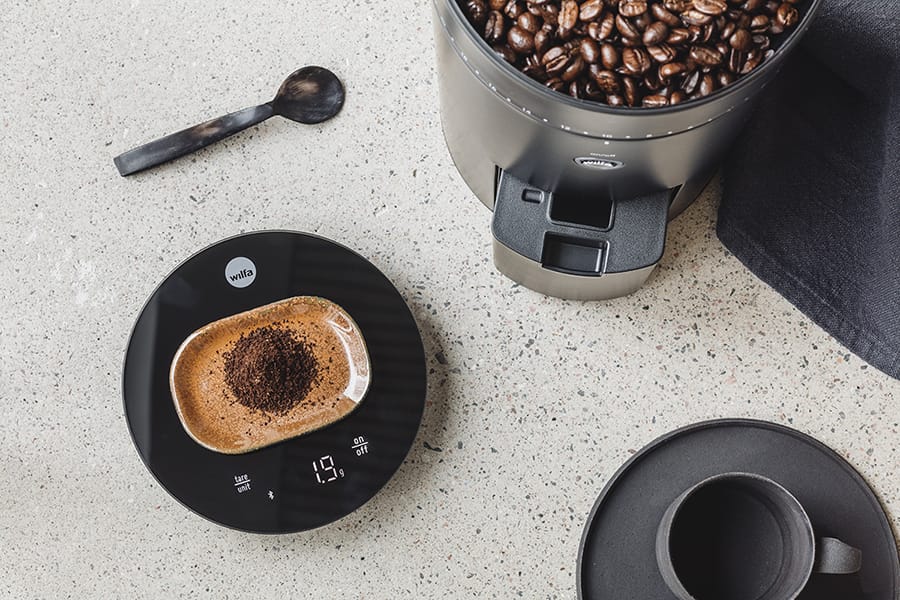
The Wilfa Zense has 30 grind settings running from fine to coarse. There's no single correct number — the right setting depends on your brew method, your beans and your taste. Start in the middle for filter coffee, brew a pot, and move two or three steps at a time: finer if it tastes sour and thin, coarser if it tastes bitter and heavy.
The Zense and the Zense Alux are the same grinder in different clothes — 40mm stainless steel burrs, 30 settings, a sealed 125g bean container, and an anti-static system, in plastic at £159 or brushed aluminium at £179.
Turning the setting changes how far apart the two burrs sit. Closer together means smaller particles, more surface area, and water that moves through more slowly. Further apart means larger particles, less surface area, and faster flow.
That's the whole mechanism, and it's why grind size is the most powerful control you have. Everything else about your brew — dose, water, temperature — is fixed the moment you press the button. Grind is the one dial that changes how fast the water gets through the coffee.
You don't need numbers to get this right. You need to know the order, because it never changes:
| Brew method | Where on the range | Why |
|---|---|---|
| Espresso | The finest end | Nine bars of pressure through 25–30 seconds of contact needs maximum surface area |
| AeroPress | Fine to medium-fine | Short immersion, then pressure — closer to espresso than to filter |
| Pour over | Medium | Two to four minutes of water moving through a cone |
| Filter coffee (your Wilfa machine) | Medium, around the middle | Four to six minutes of controlled contact |
| French press / cafetière | Coarse | Six minutes fully immersed, and a mesh filter that fine grounds slip straight through |
| Steeping / cold brew | The coarsest end | Eight minutes or more of immersion; anything finer turns to sludge |
Wilfa doesn't publish a fixed setting number for each of these, and there's a good reason for that: every grinder varies slightly in calibration, so setting 15 on one machine isn't precisely setting 15 on another. Anyone handing you an exact number for your grinder is guessing on your behalf.
Start in the middle of the range and work outwards. It's the fastest route to a setting you like, and it costs you one pot of coffee.
This is the part worth learning, because it applies to every grinder you'll ever own.
If it tastes sour, sharp or thin — like the coffee stopped halfway — the water got through too quickly and took too little with it. That's under-extraction. Go finer. Slowing the water down gives it time to dissolve more.
If it tastes bitter, dry or harsh — a lingering ashy finish, drying at the back of your mouth — the water spent too long and took too much. That's over-extraction. Go coarser.
If it tastes sweet and rounded, with the acidity reading as fruit rather than as sharpness, you're there. Note the number down. Write it on a piece of tape on the side of the grinder if you're likely to forget, because you will.
The common trap is chasing strength. If the coffee tastes weak, the answer is usually more coffee rather than a finer grind — a finer grind on an already-correct dose will just make it bitter as well as weak.
Taste is the final judge, but timing tells you quickly whether you're in the right neighbourhood. Wilfa's published targets:
| Method | Target brew time |
|---|---|
| Espresso | Around 20 seconds |
| Filter | 4–6 minutes |
| French press | 6 minutes |
| Steeping | 8 minutes |
Running long against these means your grind is too fine for the method. Running short means it's too coarse. If the filter holder on your coffee maker overflows, that's the same message stated more dramatically — the grind has choked the basket.
A setting isn't permanent, and three things will move it:
The Zense will grind directly into a portafilter, which is neater than grinding into the container and transferring. The portafilter itself isn't included.
If espresso is your main brew rather than an occasional one, though, be honest with yourself about the range you need. The Zense reaches espresso at its finest end; the Uniform Evo has 64mm burrs, 41 settings plus ten micro-adjustments between them, and included portafilter adapters — which gives you far more precision in the narrow band where espresso actually lives. We've compared them properly in which Wilfa grinder should you buy.
How many grind settings does the Wilfa Zense have?
Thirty. They run from fine, suitable for espresso, through to coarse for French press and steeping. Both the Zense and the Zense Alux share the same 40mm stainless steel burrs and the same 30 settings.
What grind setting should I use for filter coffee on a Zense?
Start in the middle of the range, around setting 15 of 30, then adjust by taste. Go finer if the coffee tastes sour and thin, coarser if it tastes bitter and heavy. Wilfa doesn't publish a fixed number per brew method because every grinder varies slightly in calibration.
Should I grind finer or coarser if my coffee tastes bitter?
Coarser. Bitterness means the water has spent too long in contact with the coffee and over-extracted it. A coarser grind lets the water through faster. If the coffee tastes sour and thin instead, go finer.
Can the Wilfa Zense grind for espresso?
Yes, at the finest end of its 30 settings, and it will grind directly into a portafilter, though a portafilter isn't included. If espresso is your primary brew method, the Uniform Evo offers considerably more adjustment in that range with 41 settings plus ten micro-adjustments.
Why has my grinder stopped grinding as finely as it used to?
Almost always a cleaning issue rather than a fault. Coffee oils and fine particles build up around the burrs and change how the grinder behaves. Clean the burr assembly and the containers, dry everything thoroughly, then re-check your setting.
Finding your setting takes one morning and then it's done. The difference between a grinder left where it arrived and one dialled in to your beans is bigger than the difference between most grinders.
Shop the Wilfa Zense · Shop the Zense Alux · See the Zense bundles