Your Cart is Empty
FREE SHIPPING OVER £150 | USE CODE WELCOME FOR 10% OFF YOUR FIRST ORDER.


The Uniform Evo gives you more control than almost any grinder at its price, which is exactly why a new one can feel intimidating. Forty-one settings, ten micro-adjustments between each of them, and a scale built into the lid. Here's how to use all of it without spending a week on it.
Start at Wilfa's published range for your brew method, grind, brew and taste. Move two or three whole settings at a time until you're close, then use the micro-adjustments to fine-tune. Go finer if the coffee tastes sour and thin, coarser if it tastes bitter and dry. Espresso wants setting 5 as a starting point.
The Uniform Evo is £359 and built around 64mm flat stainless steel burrs — large, flat burrs being the geometry that produces the most consistent particle size, which is the entire point of the name.
| Specification | Uniform Evo |
|---|---|
| Burrs | 64mm flat, stainless steel |
| Grind settings | 41, plus 10 micro-adjustments between each |
| Scale | Integrated in the lid, 0.1g accuracy, rechargeable, with timer |
| Connectivity | Bluetooth to the Wilfa SVART app for ratio calculation |
| Portafilter adapters | 51–53mm and 58mm, both included |
| Dimensions | W15 × D15 × H29 cm |
| Weight | 3.7kg |
| Certification | ECBC — one of very few certified grinders in Europe |
| Warranty | 5 years |
The ECBC certification is worth pausing on. Brewing certification for machines is relatively common; grinder certification is not. It means the particle distribution has been independently measured rather than simply claimed.
Wilfa publishes starting ranges for the 41-step scale. Treat them as a starting point rather than a destination — Wilfa's own guidance notes that every grinder varies slightly in calibration, so your ideal number may sit a step or two either side of the band.
| Brew method | Starting range | Target brew time |
|---|---|---|
| Espresso | 3–7 (start at 5) | Around 20 seconds |
| AeroPress | 14–26 | — |
| Pour over | 14–28 | — |
| Filter | 22–32 | 4–6 minutes |
| French press | 30–38 | 6 minutes |
| Steeping | 39–41 | 8 minutes |
The Evo also reaches fine enough for Turkish coffee at the very bottom of the range, which most grinders at this price cannot do at all.
This is what separates the Evo from the grinder it replaces, and it matters most for espresso.
Between each of the 41 settings sit ten micro-adjustments — so the grinder genuinely offers over four hundred distinct positions. For filter coffee that's more resolution than you need. For espresso it's the difference between a shot that runs in 20 seconds and one that runs in 32.
The sensible order of work:
If the grind setting won't move at all, don't force it. Coffee has jammed between the burrs — set the grinder to its coarsest position, run it briefly to clear, then turn slowly back towards fine.
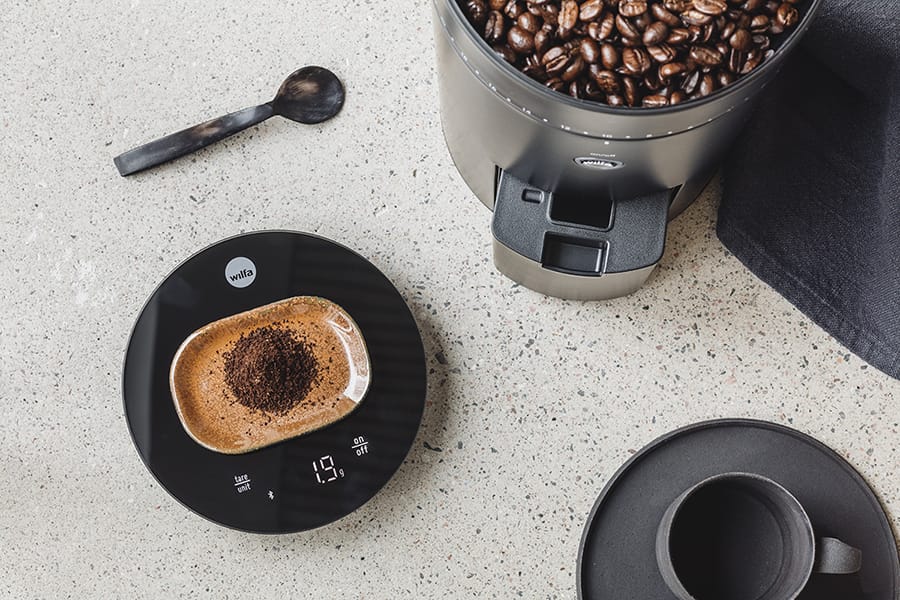
The scale sits in the lid, weighs to 0.1g, has a built-in timer and recharges. It's protected by a heat-resistant silicone cover, and it pairs over Bluetooth with the Wilfa SVART app to calculate ratios for you.
Practically, it removes the step where most home routines fall apart: weighing beans on a kitchen scale, tipping them into the hopper, losing a gram or two on the way. Weigh in the lid, grind, done. For espresso, where a 0.5g difference in dose is genuinely tasteable, it stops being a nicety and becomes the reason the shots are repeatable.
Two things the manual is quieter about. The auto-stop will halt the grinder when the beans run out or when your set time elapses — useful, and worth knowing before you assume something's wrong. And the ground coffee container is metal for a reason: it reduces static, which is why the Evo makes less mess than most grinders. If you're still getting coffee dust on the worktop, there are a few fixes for that.
Worth checking before you buy rather than after, because "58mm" is less standard than it sounds.
Two adapters are included — 51–53mm and 58mm — along with a rubber pad. The portafilter itself isn't included.
The complication is the lugs, the ears that lock the portafilter into the group head:
The Evo is designed to work with both. However, portafilter handles, spouts and lug spacing vary between manufacturers even at the same basket diameter, and a handful of models sit awkwardly — one customer has reported that their La Marzocco and Francis Francis X1 58mm portafilters didn't seat properly in the adapter.
So before ordering, measure your portafilter's basket diameter and note its lug count, and if there's any doubt, check with Wilfa support or with us first. It's a two-minute question that saves a return. If your portafilter doesn't sit in the adapter, you can still grind into the ground coffee container and transfer — less elegant, but it works perfectly well.
If you're moving up from the Uniform or Uniform+, the shape of the change is: bigger burrs (64mm rather than 58mm), the same 41 settings but with micro-adjustment added between them, and a finer reach that now includes Turkish.
Your old settings are a reasonable starting point but won't transfer exactly — different burr size means different calibration. Expect to re-dial. The Uniform and Svart grinders are both being discontinued, and the Evo is their successor.
What grind setting should I use for espresso on the Uniform Evo?
Wilfa recommends setting 5 as a starting point, within a range of 3 to 7. Pull a shot, then adjust: if it runs too fast and tastes sour, go finer; if it runs slow and tastes bitter, go coarser. Use the micro-adjustments once you're close to the right time window.
How many grind settings does the Wilfa Uniform Evo have?
Forty-one main settings, with ten micro-adjustments between each one. That gives over four hundred distinct grind positions, which is what makes it precise enough for espresso as well as filter.
Which portafilters fit the Wilfa Uniform Evo?
Two adapters are included, for 51–53mm and 58mm portafilters, and the Evo works with both two-lug and three-lug designs. The portafilter itself isn't included. Because lug spacing and handle shape vary between manufacturers, check your portafilter's basket diameter and lug count before buying if you want to be certain of the fit.
Does the Uniform Evo have a built-in scale?
Yes. There's a rechargeable scale integrated into the lid, accurate to 0.1g, with a built-in timer. It connects over Bluetooth to the Wilfa SVART app, which calculates brewing ratios for you.
Why won't my Uniform Evo grind setting move?
Coffee has become jammed between the burrs. Set the grinder to its coarsest setting, run it briefly to clear the obstruction, then turn slowly back towards finer. Don't force the adjustment.
A grinder with this much range rewards an hour of attention at the start and then asks for very little afterwards. Find your whole setting, micro-adjust once, write it down.
Shop the Wilfa Uniform Evo · Browse all Wilfa grinders · Compare the range