Your Cart is Empty
BLACK FRIDAY SALE - 26% OFF FULL-PRICED ITEMS


Most home stand mixers look alike from the outside. Inside, they knead in one of two ways, and the difference shows most with bread.
A planetary mixer spins its attachment around a fixed bowl. A rotating-bowl mixer turns the bowl and the hook together, as a bakery's spiral mixer does. For bread, the rotating bowl kneads more evenly and handles bigger batches; for small jobs like two egg whites, a planetary mixer or a hand mixer is the better tool.
The bowl stays still. The attachment spins on its own axis while it travels around the bowl, like a planet circling the sun, which is where the name comes from. Most tilt-head and bowl-lift stand mixers work this way.
It's an excellent system for cake batters, creaming and whisking, because the attachment reaches every part of the bowl. With bread it has a habit: dough tends to wrap around the hook and ride up it, so the hook spins the same ball of dough rather than working it. You stop, scrape it down, and start again.
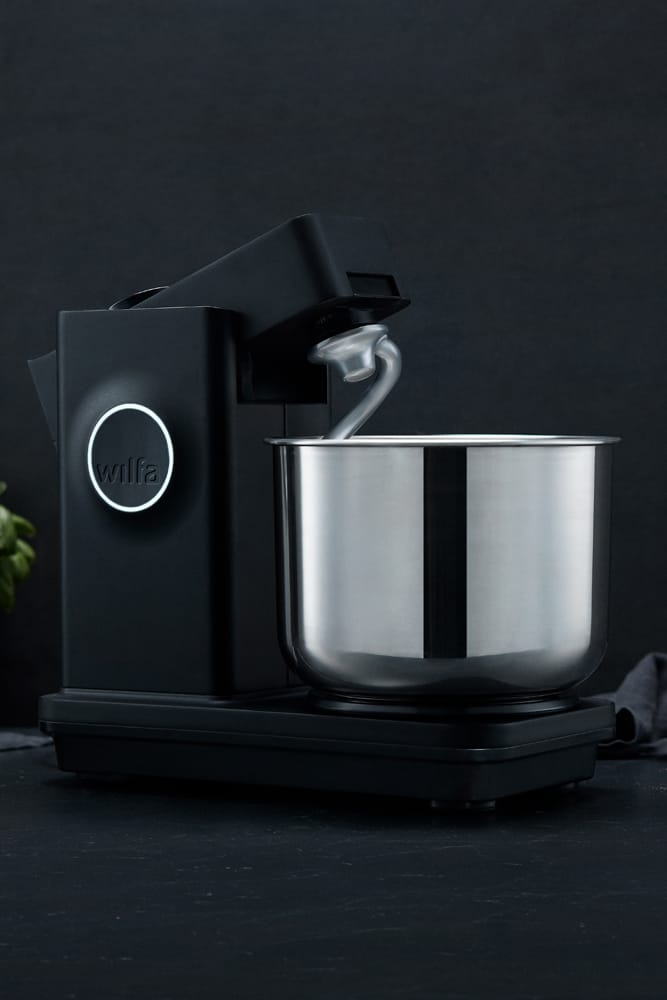
The bowl turns, and the hook turns with it. Commercial spiral mixers in bakeries work this way, and so does Wilfa's Dual-Action kneading in the ProBaker.
Because the bowl keeps bringing fresh dough to the hook, the whole batch is worked evenly. The hook can sit close to the bowl wall, so the dough is stretched against it rather than climbing up the hook. That's the motion that builds gluten, the network that gives bread its structure and chew.
| Planetary | Rotating bowl | |
|---|---|---|
| What moves | The attachment, around a fixed bowl | The bowl and the hook together |
| Best at | Cake batters, creaming, whisking | Bread and other doughs |
| Dough climbing the hook | Common with stiff doughs | Less likely, as the hook works close to the bowl |
| Large batches | Limited by the motor and the bowl's shape | What it's built for |
| Small quantities | Handles them well | Two egg whites in a big bowl is asking a lot; use a hand mixer |
For bread, a rotating-bowl mixer. Turning the bowl and the hook together works the whole dough evenly and stops it climbing the hook, which is why bakeries use spiral mixers that work this way. Planetary mixers are better suited to batters, creaming and whisking.
A stand mixer whose attachment spins on its own axis while it travels around a fixed bowl. Most tilt-head and bowl-lift home stand mixers are planetary.
Wilfa's name for the ProBaker's kneading system, in which the bowl and the dough hook rotate at the same time, like a bakery's spiral mixer.
In a planetary mixer the hook spins inside a still bowl, so a stiff dough can wrap around it and ride up, and the hook ends up turning the same ball. When the bowl turns too, fresh dough keeps arriving at the hook and is pressed against the bowl wall, so it climbs much less.
No. The ProBaker turns the bowl and the dough hook at the same time, the way a bakery's spiral mixer works. Wilfa calls this Dual-Action kneading.
Most KitchenAid and Kenwood Chef stand mixers are planetary: the attachment travels around a fixed bowl, which suits batters, creaming and whisking. The ProBaker turns the bowl and the hook together and takes up to 5kg of dough in its 7-litre bowl. Many newer Kenwood Twist accessories also fit the ProBaker with the ProBaker Tool Adapter.
Up to 5kg in its 7-litre bowl. Small batches work too: Wilfa gives a range of 500g to 5kg for the ProBaker NXT, which has the same size of bowl.
Yes, with the whisk attachment, though very small quantities are better done with a hand mixer. On the ProBaker, keep the dual whisk at 70% speed or below.
The ProBaker speed guide, and which model to buy · What makes the ProBaker different · Shop the ProBaker range