Your Cart is Empty
FREE SHIPPING OVER £150 | USE CODE WELCOME FOR 10% OFF YOUR FIRST ORDER.


Twenty speed settings and no guidance on which is which. Most ProBaker owners settle on three of them and never touch the rest, which is a shame, because the gaps in between are where the difference between a decent cake and a very good one usually lives.
The ProBaker's dial runs from 0 to 100 in steps of 5, giving twenty settings. Use 5–20 for folding and combining dry ingredients, 20–40 for kneading dough, 40–60 for creaming butter and sugar, and 50–70 for whisking. The one rule worth memorising: never run the dual whisk above 70%.
The dial isn't a percentage of power, it's a position on a scale — and Wilfa publishes exactly what each one does. Two figures matter: the stirring speed, which is how fast the attachment travels through the bowl, and the motor speed behind it.
| Speed level | Stirring speed (RPM) | Motor speed (RPM) |
|---|---|---|
| 5 | 55 | 1130 |
| 10 | 68 | 1394 |
| 15 | 78 | 1600 |
| 20 | 89 | 1824 |
| 25 | 100 | 2050 |
| 30 | 111 | 2280 |
| 35 | 123 | 2521 |
| 40 | 135 | 2767 |
| 45 | 147 | 3013 |
| 50 | 158 | 3239 |
| 55 | 170 | 3485 |
| 60 | 182 | 3731 |
| 65 | 194 | 3977 |
| 70 | 206 | 4223 |
| 75 | 218 | 4469 |
| 80 | 230 | 4715 |
| 85 | 241 | 4940 |
| 90 | 253 | 5186 |
| 95 | 265 | 5432 |
| 100 | 275 | 5700 |
| Pulse | 275 | 5700 |
Two things to take from this. The scale is close to linear, so moving from 40 to 60 is a genuine, predictable increase rather than a vague "a bit faster". And Pulse is simply full speed in short bursts — useful for bringing a mixture together without working it.
5–20 — folding, combining, starting everything
Start almost every mix here. Dry ingredients combine without flour leaving the bowl, and anything already aerated — a batter you're folding fruit into, meringue going into a mixture — keeps the air you put into it.
It's also the speed to start at when you add flour to a wet mixture. Going straight to a middle speed is how kitchens end up dusted.
20–40 — kneading dough
The spiral dough hook works in this band. The ProBaker's Dual-Action kneading rotates the bowl as well as the hook, which is why it develops gluten faster than a mixer that only spins an attachment.
The machine handles up to 5kg of dough in a 7-litre bowl, which is a great deal of bread. Heavy, stiff doughs want the lower end of this range.
40–60 — creaming butter and sugar
The stage that decides how a cake rises. You're beating air into the fat, so it wants sustained medium speed and more time than most recipes suggest — five minutes is not too long for a genuinely pale, fluffy result.
Use the flexi beater here rather than the whisk. Its flexible edge scrapes the bowl as it turns, which matters because butter and sugar climb the sides and stop being mixed.
50–70 — whisking cream and egg whites
And this is the ceiling.
Wilfa is specific about this and it's the most useful thing in the manual: don't run the dual whisk above 70%.
It sounds counterintuitive — surely faster whisking means more air? It doesn't. Above 70% the whisk moves fast enough to start knocking air back out of the mixture as quickly as it incorporates it. Cream goes from soft peaks to grainy and over-whipped in seconds, and egg whites lose the stability you're trying to build.
If your whipped cream has ever gone from perfect to split without warning, this is almost certainly why.
Related, and worth knowing before you assume something's wrong: if the whisk seems to be hitting the bottom of the bowl, there's usually too little in it. The dual whisk adjusts its height according to the contents, so a very small quantity leaves it sitting lower than you'd expect. Two egg whites in a 7-litre bowl is asking a lot — use a hand mixer for small jobs.
The ProBaker has a bottom-mounted motor, a rotating bowl and hook, three drive belts and a metal chassis. All of that makes noise, and a metal-bodied machine transmits it rather than absorbing it the way a plastic one does.
Wilfa's own tip for reducing it while kneading: raise the speed to around 50% or more, and add liquid. A stiff dough at low speed is the loudest combination there is, because the machine is working hardest against the most resistance.
| Attachment | Use it for | Speed |
|---|---|---|
| Spiral dough hook | Bread, pizza, enriched doughs | 20–40 |
| Flexi beater | Creaming, cake batters, icing | 40–60 |
| Dual whisk | Cream, egg whites, meringue | 50–70, never higher |
| Splash guard | Adding liquid or flour mid-mix | Any |
All of these come with the machine, along with a dough scraper and the 7-litre stainless steel bowl. Replacements are available separately — a stainless steel dough hook, a flexi beater paddle and a 7L mixing bowl.
Beyond the standard set, the ProBaker Tool Adapter at £99 fits many Kenwood Twist accessories to the machine, including meat grinders, pasta rollers and vegetable slicers.
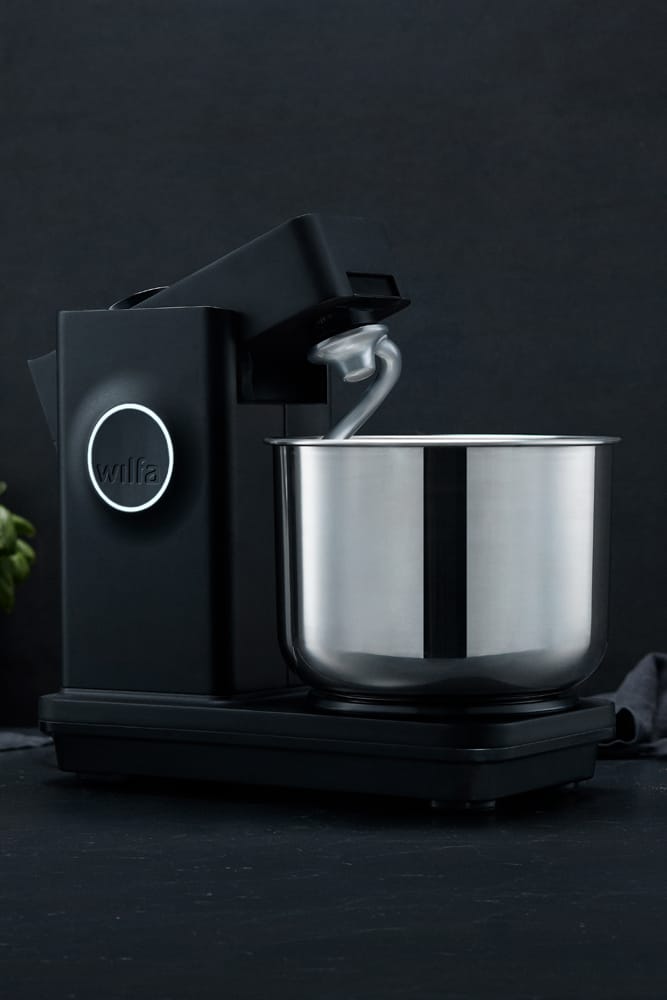
All three ProBaker models share the same platform — Dual-Action kneading, a 7-litre bowl, a 700W motor, twenty speed settings and up to 5kg of dough.
What speed should I use to knead bread dough in a ProBaker?
Between 20 and 40, with the spiral dough hook. Stiffer doughs want the lower end. The machine handles up to 5kg of dough in its 7-litre bowl.
Why shouldn't I whisk above 70% on a ProBaker?
Above 70% the dual whisk moves fast enough to beat air back out of the mixture as fast as it incorporates it. Cream over-whips and turns grainy, and egg whites lose stability. Wilfa specifically advises against running the dual whisk above 70%.
What are the ProBaker speeds in RPM?
The dial runs from 0 to 100 in steps of 5. Level 5 gives 55 stirring RPM, level 50 gives 158, and level 100 gives 275 stirring RPM at 5,700 motor RPM. Pulse runs at full speed in bursts. The full table is published on the Wilfa UK FAQ page.
Why does the whisk hit the bottom of the bowl?
There's usually too little in the bowl. The dual whisk adjusts its height according to the contents, so very small quantities leave it sitting lower than you'd expect. Use a hand mixer for small jobs.
Do Kenwood attachments fit the Wilfa ProBaker?
Many Kenwood Twist accessories do, using the ProBaker Tool Adapter, sold separately at £99. That includes meat grinders, pasta rollers and vegetable slicers.
Most of what separates a good bake from an ordinary one happens at a speed and for a length of time the recipe never mentions. The dial is worth learning.
Browse the ProBaker range · Attachments and spare parts · If your mixer stops mid-knead